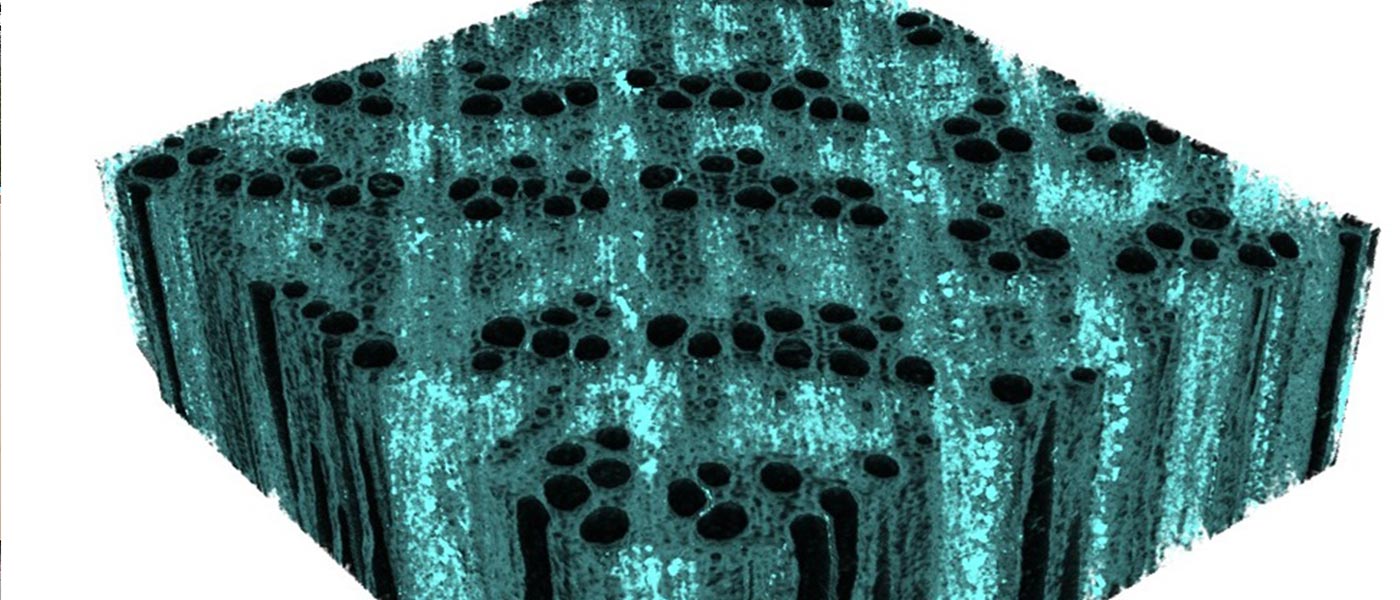
Above: A microCT image shows the distribution of the iron mineral in the wood cell wall (in turquoise).
Credit: Florida Atlantic University
Researchers are adding “nanoscale minerals” to wood to try make it better performing and more eco-friendly.
Researchers from Florida Atlantic University, along with the University of Miami and Oak Ridge National Laboratory, are trying to enhance the properties of wood to create a “high-performance, eco-friendly material,” according to a report on interestingengineering.com.
“By looking at wood at different levels – from the microscopic structures inside the cell walls all the way up to the full piece of wood – we were able to learn more about how to chemically improve natural materials for real-world use,” said Vivian Merk, senior author of the project.
The report said that the researchers wanted to know if adding these minerals could make wood stronger without adding major weight, cost, or environmental impact. After looking into various kinds of ring-porous hardwoods like oak, maple, cherry and walnut, the team chose red oak. They produced ferrihydrite, a naturally occurring iron oxide mineral with the goal of introducing this mineral directly into the cell walls of the wood.
They discovered that doing so successfully strengthened the tiny cell walls within the wood while only adding a minimal amount of extra weight. And despite the increased durability of the wood’s internal structure after treatment, its overall behavior when bent or broken did not significantly change.
The report said that this newly created, environmentally friendly material has the potential to be a substitute for steel and concrete in buildings, bridges, furniture and flooring. “Wood, like many natural materials, has a complex structure with different layers and features at varying scales,” said Merk. “To truly understand how wood bears loads and eventually fails, it’s essential to examine it across these different levels.”
“By reinforcing natural wood through environmentally conscious and cost-effective methods, our researchers are laying the groundwork for a new generation of bio-based materials that have the potential to replace traditional materials like steel and concrete in structural applications,” Stella Batalama, the dean of the College of Engineering and Computer Science, wrote.
While the new report did not say when these new materials might be used commercially in the marketplace or what their added cost would be, it reported their use could lead to reduced carbon emissions, less waste, and sustainable construction.
Image: Florida Atlantic University